Samuel Davis
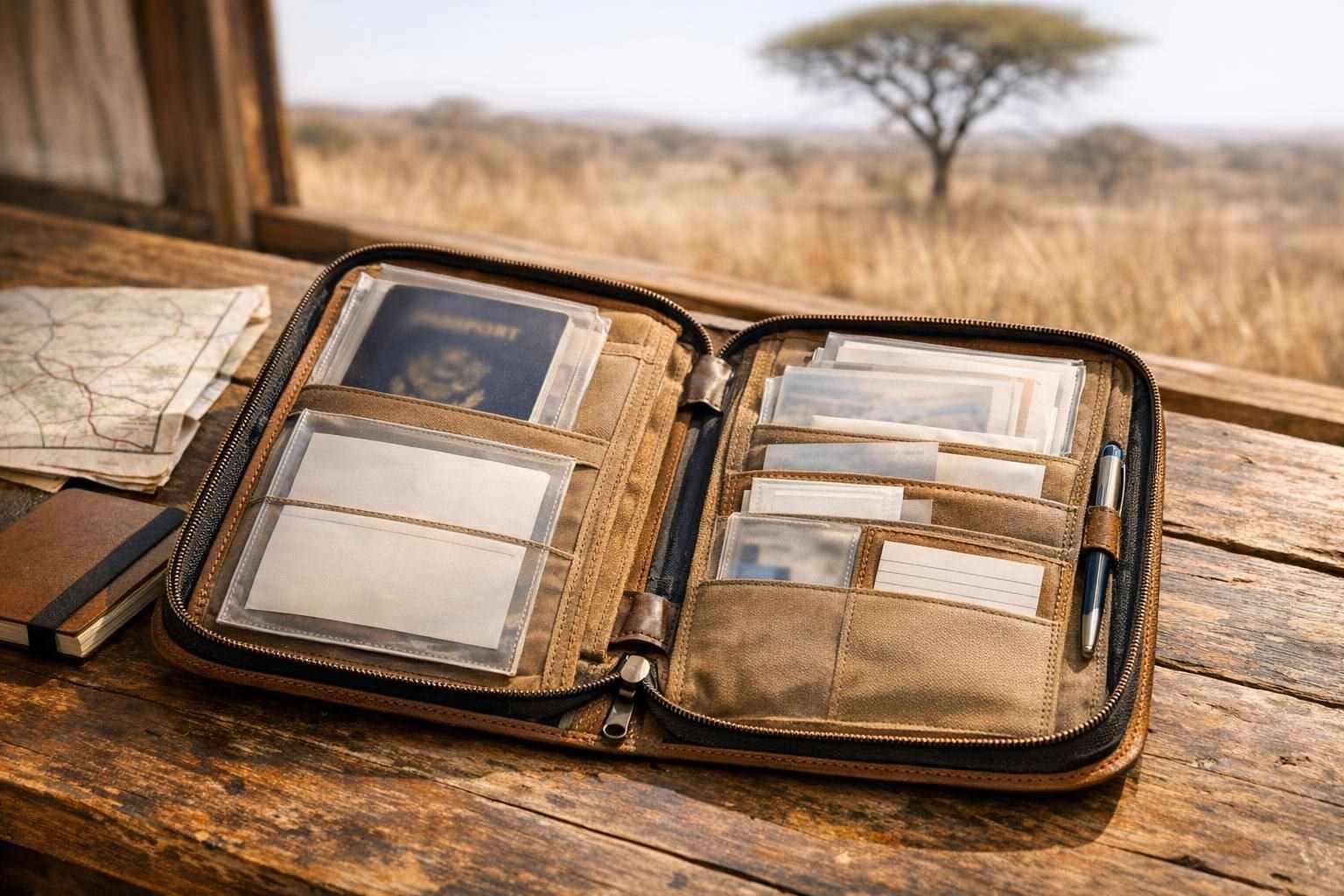
airport, border, lodge desk or charter check-in when all your trip paperwork is not in order. Set up a system to manage your trip documents. A workable filing system enables you to easily locate required documents, to distribute only the information required by others and to identify if documents have expired. A good system does not consist of a big heap of documents but of a small set of up-to-date documents in paper and digital format, relevant for the decisions you will take on your journey.
Start with a master document list
Use a document list as your start point for planning. Organize your documents into 4 categories of interest for travel planning: Identity & Entry; Transport & Stays; Health & Insurance; and Other Trip Documents. And make sure that all your entries have been covered by your booking confirmations.
For a guided hunting trip, this would include your passport with applicable visas for travel into countries on your itinerary, as well as scanned copies of flight tickets, all transfer arrangements and accommodation confirmation documents. You would also include contact details for emergency contacts at home as well as written arrangements with your outfitter or travel coordinator.
Just because you have the document does not mean it is useful! Compare the name on the document with the name on the booking, the passport number with the number on your passport, and check that the travel dates, destinations and spelling are all correct. There could be a minor error that has not been picked up until it is too late.
Check passport and visa planning early
Consider the full itinerary of your trip (not just the outward flight) when researching your travel documents. You may be traveling through a transit country, with an overnight stopover, or crossing a border as part of a land transfer between destinations. Each of these sections of your journey may have their own requirements, which could change while your tickets are still being purchased.
Review current information from relevant government websites (such as the Department of Foreign Affairs), or embassies/consulates websites. Specifically check for the most up to date entry requirements for your nationality, for travel through transit countries overnight connections etc for the purpose of your trip and note the date that you reviewed this information.
Remember to note the date that you checked for this information and keep a copy of the official government web page or other reference that you used to check. This does not replace the requirement for you to have completed the necessary steps, but rather provides evidence of actions completed.
Keep paper and digital copies apart
Keep all the copies (not just originals) in one place. That place is NOT in your checked luggage! Having all your copy's in one place like a locked cabinet or a safe will allow you to have all your copy's ready to go when you travel. Make sure you leave a second complete set with a trusted family member or friend.
Name the files clearly, rather than saving a long chain of "scans". That means instead of 'scan004.pdf' call it "John Smith – Passport.pdf" or a similar combination that allows you to find the correct file quickly when searching for it later.
It's also very important to keep a working copy of the planning file up-to-date. As you come across more information (e.g. flight changed or got new insurance certificate) remove the old copies from your working folder. Looking at old and new versions side-by-side creates more confusion than required.
All sensitive information should be shared on a case by case basis with the necessary individuals. The information shared should be relevant to their involvement with your trip and methods of sharing information should be secure wherever possible.
Prepare the insurance record, not just the policy
When organizing your travel insurance documents it is also a good idea to organize them in a way that allows for quick reference to answers to a number of questions that may arise whilst abroad. The main items to include would be the policy wording, the policy certificate, the assistance telephone number, details of what to do for making a claim and any exclusions that apply to your trip.
A simple A4-sized document that contains the policy number, the contact number for assistance, a list of any other information that you consider to be important for the emergency services to know (e.g. any allergies or previous medical problems that you consider it wise to disclose) and contact details for someone back home.
Also, it is a good idea to check with your insurer what sort of documentation will be required to make a claim and this should be recorded as well as kept with your other travel documents.
Organize hunting and field paperwork
Try to organize the documents specific to the hunting trip as described above in the Trip documentation section as well. A written copy of the agreed written itinerary, the contact information for the outfitter, as well as for the accommodation, the transfer information, as well as any other written documentation provided for the planned activities all need to be stored together and marked for which have been confirmed and which still need to be completed.
When traveling with sporting gear such as guns, don't rely on the booking confirmation of your flight for permit to carry your sporting goods. Different countries, modes of transport, routes and departure/destination countries can have different requirements and you need to check with the relevant authorities and carrier in advance of your trip.
Also keep any necessary information for the field with you. Make sure to include any information concerning agreed species, terms and conditions of the hunt, as well as any restrictions placed upon you as a hunter. In case of any questions in the field it is also wise to include the contact information for your trip coordinator.
Do not include in your travel documents any personal information not required by another. A guide will need your arrival time and your contact details in an emergency, but not the remainder of your insurance documents.
Run a departure and arrival check
7 days before travel – check your completed Checklist against the complete paper set of documents, the copies stored on your phone, the online copies stored in encrypted cloud storage, and the paper copies left with your trusted contact at home. Ensure all copies of scanned documents are readable, that you have charged the batteries of any necessary devices, and that you have written the emergency numbers in a form that will be usable when abroad.
Of course the originals for the documents you are taking in your hand luggage have to be in a safe place, but still easily accessible when you check in for your flight, have to go through border control etc. How you do this depends on your route and the airline you are flying with.
Be sure to confirm with all parties who has copies of your documentation. At handovers such as transferring from one vehicle to another be sure to verify that all relevant parties have a copy of the required documentation. If there are changes to your flights, border crossings, etc. be sure to update your index as soon as possible rather than trying to remember the change later.
All requirements for entry, for your insurance, your equipment and for your health might change so always check the latest requirements with official government websites, with your insurance company, your airline, travel agent or tour operator and your trip coordinator. Having all your travel documents in order can help to solve any problems that may arise before they become a field problem.